
What a Summit County Resident Lookup Confirms
A Summit County resident lookup works best when the record matches the claim being tested. Property Access can connect a named owner to a parcel. Recorded documents can confirm that a party appears in a transfer. Voter information can confirm registration and precinct details for a known person. Court and Probate indexes can place a name in a dated case. Vital, obituary, and cemetery sources can support a historical relationship or endpoint. None of those sources is a complete roll of every person at an address, so treat each hit as one part of a documented trail.
| Record | What It Confirms | Where to Search | Access |
|---|---|---|---|
| Property record | Recorded owner-to-parcel association | Fiscal Office Property Access | Daily-updated public search |
| Voter registration | Registration, precinct, and polling information | Ohio My Voter Information | Public with statutory exclusions |
| Court case index | Case number, type, party role, and date | Clerk and Common Pleas portals | Public index, restrictions apply |
| Probate or vital trail | Estate, marriage, death, or relationship clue | Probate, SCPH, and Special Collections | Portal, counter, mail, or research room |
| License or business record | Credential or documented affiliation | eLicense Ohio or Business Search | Public statewide lookup |
Start with an owner search when the question is about a particular parcel. Start with a court or Probate search when an estate, case, or license is already known. For a former household, use the historical directory and obituary path instead of treating current records as a time machine. A dated public association is more useful than a name alone.
Search Summit County Property by Name
Fiscal Office Property Access is the county starting point for a recorded owner or parcel connection. Its published fields include Parcel, Route, Owner, Address No., Street, Zip, Tax Year, sorting, and results-per-page controls. Owner instructions show last name first and examples using percent separators, such as Smith%John%. For an address, the instructions use a number and street name without a directional or suffix. The county says the data update daily, so select the applicable tax year before relying on a current-owner result.
Property records are especially useful for an estate question, a seller-verification question, or a house-history search. They are not a complete occupant list. A parcel card can distinguish the physical situs from correspondence information when both appear, and the two should not be treated as the same thing. Match any owner name to the parcel number and legal description before connecting it to a Recorder document.
| Property Access field | Local use |
|---|---|
| Owner | Tests a recorded owner name; published examples include percent separators. |
| Address No. and Street | Locates a parcel from a known physical address. |
| Zip | Narrows a property query, without creating a person roster. |
| Tax Year | Sets the time frame for an owner or appraisal question. |
Check Summit County Court Name Results
The Common Pleas name search requires at least three letters of first and last name together, or a company name, and allows Criminal, Civil, or All case types. It is an initial index, not the complete file. The page directs users to the Clerk for the record itself. A name match needs a case number, date, type, and party role before it can be connected to anyone else.
The Clerk division selector separates Civil, Domestic, Criminal, Court of Appeals, Naturalization, and historical records. Its published party-result example can show a selected name/address, alias indicator, and case number, but the display is not a disposition or a certified file. When a person has a common name, compare the case period and division with a separate dated record rather than choosing the first matching row.
Use the Clerk’s official record-search entrance for the correct division. Akron Municipal Court keeps its own docket route for matters in its jurisdiction, and Probate is a separate Common Pleas division. Court systems are organized by case type and geography, not as one countywide resident index.
Note: A public case hit can identify a filing, but it does not establish a person’s present location or resolve a same-name match.
Verify a Summit County Resident Across Records
Use three independent details as a practical threshold: a name variant, a dated official record, and a location, relationship, or case context. For example, a property owner can be tested against a deed’s legal description and a dated directory address. A Probate party can be tested against an obituary relationship and a case number. Disagreement is a reason to pause, not a reason to select the closest-looking result.
- Search Property Access by owner name and record the parcel, tax year, situs, and legal description that appear in the current record.
- Search the Recording Division for the same name around the relevant period. Compare the deed’s parties and legal description, not just a matching street label.
- Test the name in the appropriate Clerk or Probate index, saving case number, case type, filing period, and party role.
- For a historical endpoint, compare a directory, obituary, cemetery, or vital source. Request the needed public copy from its actual custodian.
- Docket
- A court’s running case record, showing filings and events rather than a general biography.
- Index and image
- An index points to a record; an image is a view of the recorded document and may be unavailable or restricted.
- Certified copy
- A custodian-issued copy carrying its official certification, requested when an ordinary web display is not enough.
Use Ohio Voter Tools With Care
Ohio My Voter Information is a confirmation tool for a known person. It requires first name, last name, and county. The result can provide registration, precinct, polling location, and related election-administration information. It is not an all-person street browse. Ohio law excludes full or partial Social Security numbers, driver or state ID numbers, phones, emails, confidential registrations, protected addresses, and other protected data from disclosure.
For a documented public-file request, the Secretary of State’s DATA Act portal archives county registration snapshots for at least 22 months after an election. Its county list can be set to Summit County, but the download system is not a quick resident search. The local fallback is the Summit County Board of Elections, which can help locate a clearly described public election record. An absence can reflect a protected record or ordinary administrative change.
Follow Summit County Probate and Vital Clues
Probate eServices supports searches by case number, type, name, attorney, and ticket or citation number. Cases issued before December 29, 1999 can be searched by name. Public case images may be available, while confidential entries and some documents remain unavailable online. Probate also keeps the county’s marriage-license records, with its Historical Marriage Index running from September 9, 1980 forward.
For a death, birth, or historical family connection, Summit County Public Health offers Ohio certified birth and death copies through online, phone, counter, and mail channels. The cited current price is $22 per certified copy, with an online card-processing charge listed separately. Ordinary Ohio birth and death records are public, but a death record’s Social Security number has a special first-five-years restriction under R.C. 3705.23. Library obituary, cemetery, funeral, and estate resources are useful corroboration, not substitutes for a custodian’s record.
For a local view of the Clerk request route, the electronic public-records form shows how the office identifies a case and chooses delivery. The screenshot below reflects that official route. A precise case number, party name, file date, and requested document make a request easier to process.
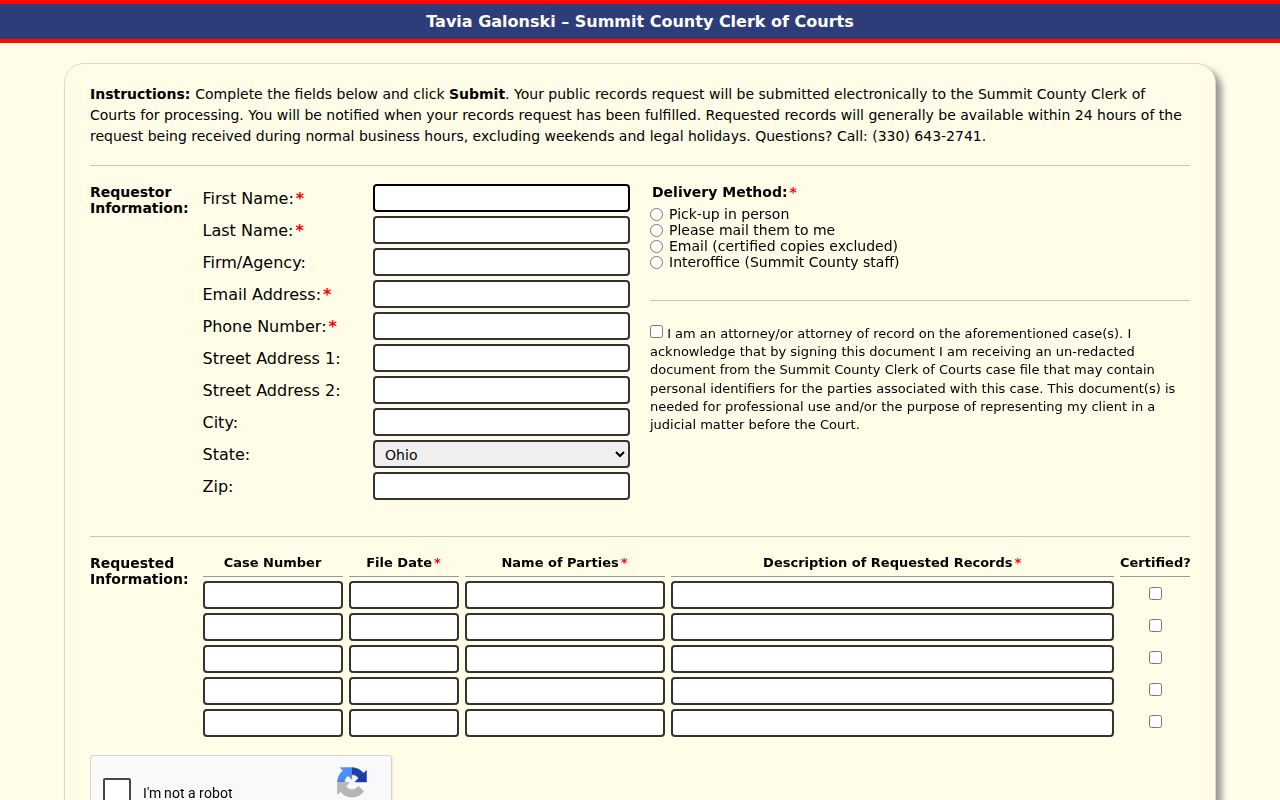
The request form is a fallback when the online index identifies a case but does not provide the needed public document or image.
Confirm a Summit County Affiliation
Some official statewide systems add context but do not show a home. eLicense Ohio searches a professional credential by last name and first initial plus board, or by complete license number. The record can show status, board, license type, dates, and a listed city. Ohio Business Search and UCC filings can document an entity or filing relationship. Read every role literally: an agent, officer, debtor, or credential holder is an affiliation, not proof of a current residence.
The eLicense public interface below is useful when a credential is the independent, dated fact that distinguishes two similarly named people. It should be paired with the source that directly answers the address, estate, or court question.
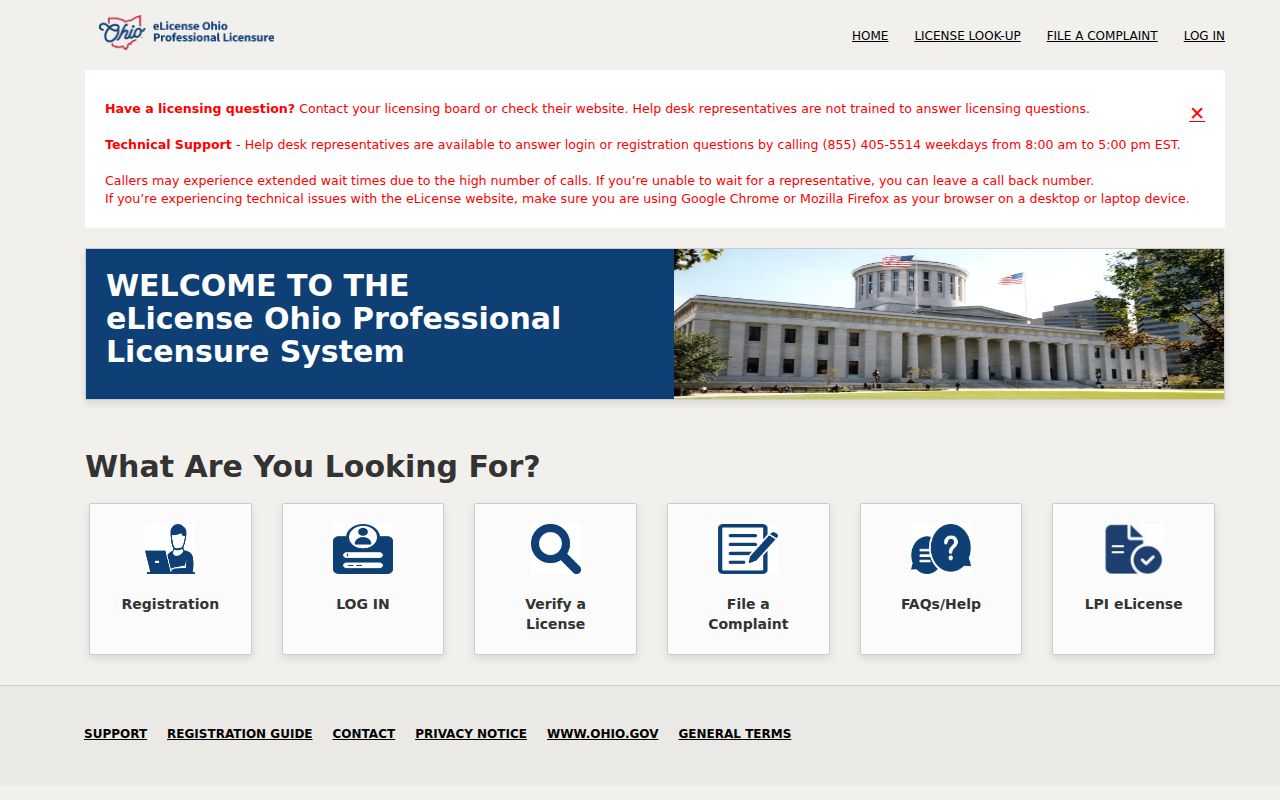
A city listed in a credential result is geographic context, not a street-level confirmation.
Request a Summit County Public Record
Ohio’s Public Records Act, R.C. 149.43, requires public offices to make records available for prompt inspection and to produce copies within a reasonable period, subject to exemptions. When a web search stops, use the actual custodian’s counter, mail route, electronic request form, or reading room. The Clerk recommends web retrieval for later files and requests for earlier files; its File Room at 205 S. High Street is the in-person route for older material. The Recorder’s fourth-floor public computers and the Library’s Special Collections research room supply parallel routes for land and historical records.
Ask to inspect first when the exact document is unknown, then note the case, parcel, book/page, or reception reference before ordering only the needed copy. The Recorder’s web documents begin in 1988, while its Index Book Archive Viewer carries the 1840–1988 path. A narrowed request is more useful than a broad name request.
Summit County Resident Lookup Limits
Ohio public access has boundaries. Safe at Home gives eligible people a substitute address and shields their address, phone, and identifying information from public records. R.C. 3503.13 protects confidential voter records and key identifiers. R.C. 149.45 establishes online-redaction procedures, and courts may restrict juvenile, adoption, sealed, expunged, or confidential material. A missing listing does not prove that a person is absent, and a public record should never be republished as a reason to contact or target someone.
Lawful use. Use a Summit County resident lookup for personal, lawful research, family history, estate work, or civic questions. Ohio law prohibits stalking and harassment; confirm material facts with the office that keeps the record.